Remove BOOT Ransomware
The word ransomware most likely originated from a combination of two words, "ransom" and "warrant". The term has been applied to software that holds an individual or business to ransom using encryption if a sum of money is not paid within a certain period. In 2006, the first known ransomware attack was launched against Danish CSC. Ransomware is typically spread via malicious spam emails containing infected attachments or links containing malicious code. The malware then infects the target computer and performs a number of functions ranging from encrypting files on the computer with strong crypto algorithms to destroying data on local disks as well as network-attached storage devices, so as to render them unusable without paying the attacker's demand for money.
What is the BOOT Ransomware?
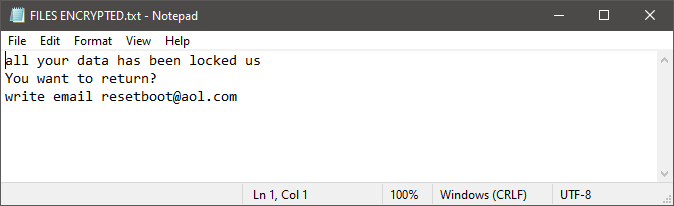
BOOT is one such piece of ransomware. It belongs to the Dharma family of ransomware. Typically, malware of such a type is designed to encrypt your files, change their names, and create ransom messages. The BOOT Ransomware changes the name of every encrypted file by adding your ID, resetboot@AOL.COM email address and appending '.BOOT' to the filename. For example, it will rename '1.jpg' to '1.jpg.id-[your_ID]-[resetboot@AOL.com].BOOT', '2.jpg' to 2.jpg.id-[you_ID]-[resetboo@AOL.com]BOOT', and so on. It displays a ransom message in pop-up window and generates a text file named FILES ENCRYPTION.TXT containing another ransom message.
Users often get infected with malware unintentionally. They may be infected when they download software from untrustworthy sources, crack software, use software update tools that are not trustworthy, or download software from untrusty sources. Malware can also be installed on a computer without the user's knowledge. The best form of protection is using an up-to-date anti-malware tool.
Typically, only the cyber criminals who create ransomware-type programs have the tools necessary to decrypt files they have encrypted. Unfortunately, there are currently no free ways to decrypt files that have been encrypted by such programs. In such cases, only the option of restoring files from a backup remains. Of course, before you proceed to recover your data, you should make sure to eliminate the BOOT Ransomware with the help of an up-ot-date anti-malware app.